SVR is governed by a nine-member board consisting of two Monterey County Board of Supervisors, three Salinas City Council members, and one City Council member each from the cities of Gonzales, Soledad, Greenfield, and King.
The Board meets every 3rd Thursday of the month at 6:00 p.m., unless otherwise noted, in the City of Gonzales Council Chambers, 117 Fourth Street, Gonzales, CA 93926.
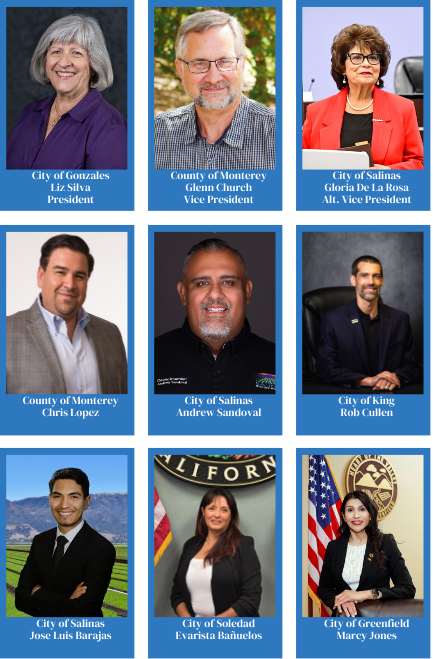
The Executive Committee is an advisory committee to the Board of Directors and oversees issues related to finances, personnel, and agency policies. Composed of the SVR Board: President; Vice President, Alternate Vice President; and Immediate Past President (discretional).
The Executive Committee meets, unless otherwise noted, the Wednesday two weeks before the regular Board of Directors meeting at 2:30 p.m. in SVR’s Conference Room, 126 Sun Street, in Salinas.
Board Alternates:
Luis Alejo, County of Monterey; Scott Funk, City of Gonzales; Maria Corralejo, City of Soledad; Rachel Ortiz, City of Greenfield; Oscar Avalos, City of King
Jolon Road Pavement Rehabilitation Project
The Board approved and awarded the project. It was completed in December of 2024.
North Monterey County Transfer Station Project
The Board continues to support the project with the Engineering and Environmental Compliance Manager working diligently on the requirements, holding meetings with multiple agencies to identify the projected steps required, submitting permitting applications and documentation. Several steps have been identified to move forward.
Johnson Canyon Road Entrance Project
The Board supported staff’s recommendation to defer the project until after the design and development of Landfill’s Module VIII.
Johnson Canyon Landfill Gas Header Improvement Project
The Board approved the in-house project. This project will help to continue managing the methane and other greenhouse gases generated the Johnson Canyon Landfill by Organic materials in garbage.
Litter Abatement Efforts
The Board approved funding various activities and contracts that support the education, prevention, and clean-up of litter and illegal dumping. Additionally, since June of 2018 the Board has supported the County of Monterey (COM) with a Litter Abatement Memorandum of Understanding (MOU) in the amount of $100,000 to combat the notable increase in illegal dumping and litter in and around the rural farm areas. This year the Board approved an additional $25,000 for Fiscal Years 2025-26 and 2026-27 in the MOU with the COM.
Recognitions & Awards
Alisal Union School District
Recognized for implementing District-wide Food Waste Recycling Programs in compliance with Senate Bill 1383.
Villa San Miguel Apartments and Pajaro Townhomes Apartments
Recognized by the Board for their successful food scrap programs.
Edible Food Recovery Grants
Awarded for its fourth cycle to help six local organizations enhance the food recovery network.
2024 Employee of the Year
Tomas Lopez, Heavy Equipment Operator was recognized as the 2024 Employee of the Year after being selected by his peers.
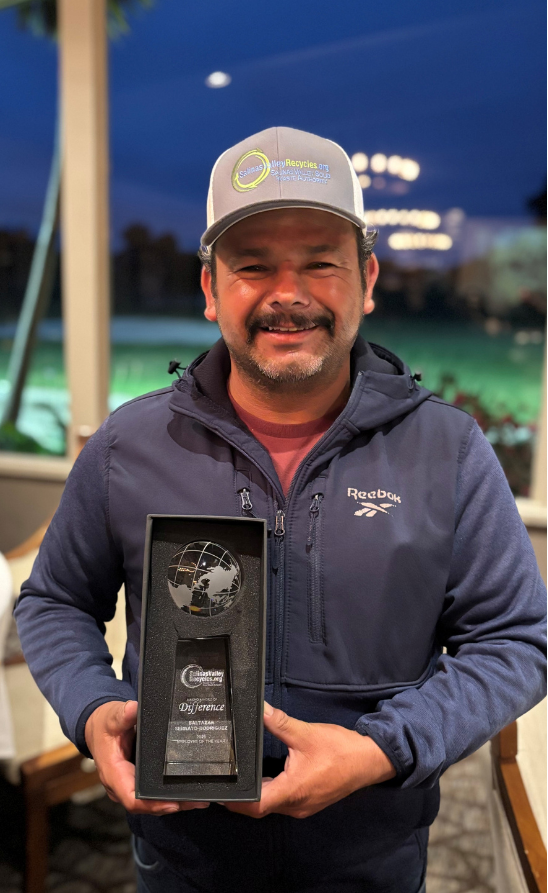
Employee of the Year: Baltazar Serrato
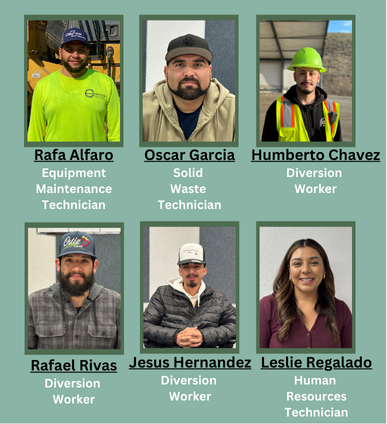
New Hires
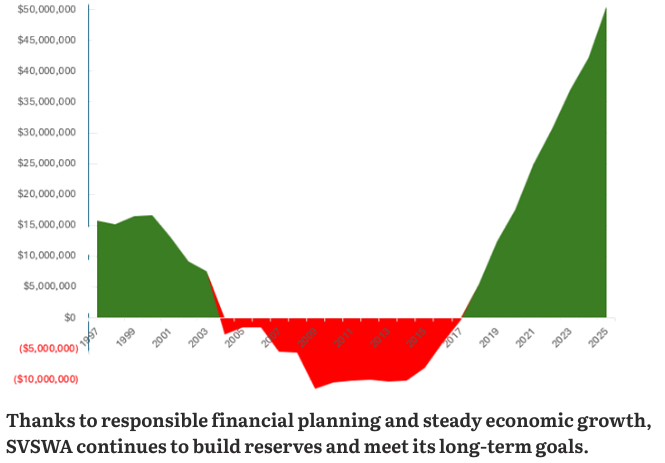
SVSWA increased its net position by an estimated $8.3 million during the 2024–25 fiscal year. Some of the key practices that SVSWA follows to help with financial sustainability are as follows:
SVSWA sets aside funds now to cover landfill closure and post-closure maintenance costs for Johnson Canyon, SVSWA’s last active landfill. In accordance with CalRecycle requirements, the Authority has set aside $5,241,069, which is sufficient funds to fully fund all accrued closure costs for Johnson Canyon Landfill as of June 30, 2025. Additionally, all accrued post-closure costs in the amount of $2,828,959, have been fully funded. Post-Closure maintenance of the site will be for a minimum of 30 years after the landfill closes.
The Authority’s Financial Policies require prioritizing the use of cash surpluses to pay off its Pension Liability whenever possible, ensuring that liabilities are paid off with money currently available. This practice has saved the Authority $1.5 million in future interest payments.
In 2022, SVSWA has refinanced its bonds, resulting in $1.6 million in interest savings and allowing the Authority to pay off its debt a year early.
Balanced Budget
Operating Revenue = Full Cost of Services
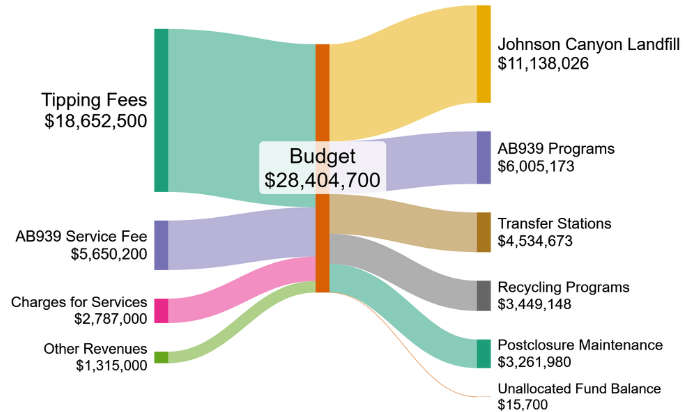
By closely monitoring revenues and expenditures, the Authority ensures that spending aligns with organizational goals. Programs such as organics and AB939 Services are fully self-funded. Additionally, the budgeting process allocates funds for recurring capital expenditures so that the Authority does not incur additional debt, or require outside revenue sources . Overall, this approach fosters financial resilience and long-term sustainability.
 For the 11th consecutive year the Government Finance Officers Association of the United States and Canada (GFOA) awarded the Certificate of Achievement for Excellence in Financial Reporting to SVSWA.
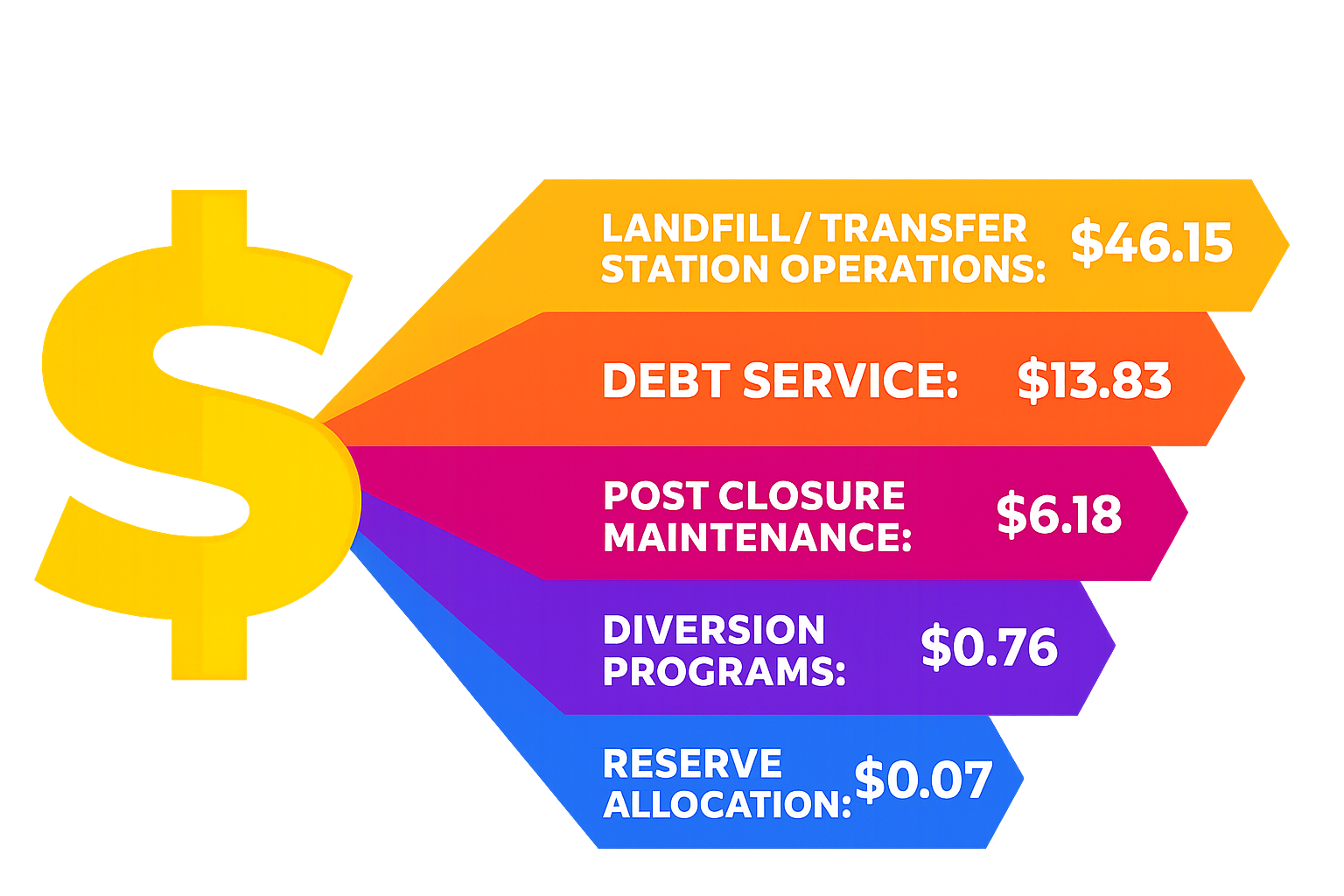
As of July 1, 2025, SVSWA charges $67.00 per ton for disposal.
Fees are allocated into these 5 categories:
69% – Landfill & Transfer Station Operations
Covers daily landfill operations, including waste burial and the installation and upkeep of critical systems like gas collection, and funding equipment replacement reserves.
21% – Debt Service
Paying down the debt SVSWA was founded with—scheduled to be fully repaid in just five years.
9% – Post-Closure Maintenance
Ensures safe management of landfill sites for up to 30 years after closure.
By planning ahead, SVSWA prevents future generations from paying extra fees to manage old waste.
1% – Diversion Programs
Supports recycling and waste diversion programs. While most are funded through local AB 939 fees, some are supplemented by landfill fees.
0.1% – Reserve Allocations
Money is set aside in reserves to cover future needs without creating new debt.
Visualizing Impact
By the Numbers: How much did we Recycle?
Mattresses: 4 Space Shuttles
330 Tons of mattresses (78 Tons/Space Shuttle)
Cardboard: 6 Statues of Liberty
910 Tons of Cardboard (150 Tons/Statue)
Batteries: 18 Grand Pianos
18.000 pounds of household batteries (990 lbs./Piano)
E-Waste: 40 Elephants
267 Tons of e-waste (6.7 Tons/Elephant)
Metal: 14.5 Houses
2,519 Tons of Metal (172 Tons/House)
Sharps: 3 Polar Bears
3717 LBS. Sharps (1,149 lbs/Polar Bear)
HHW: 4 Blue Whales
426 Tons of HHW (115 Ton/Blue Whale)
Plastic: 52 Honda Civics
79 Tons of Plastic (1.5 Ton/Honda Civic)
Carpet: 20 Giraffes
41 Tons of Carpet (2.13 Tons/Giraffe)
Clothing: 3 School Buses
38 Tons of Textiles (20 Tons/Full Bus)
Paint: 8 T-Rex
80 Tons of Paint (9.7 Tons/T-Rex)
Tires*: 19.5 Cruise Ship Anchors
242 Tons of Tires (12.5 Tons/Anchor
*Free during Amnesty Events
Each year, all California jurisdictions must report how they divert 50% of their jurisdiction’s waste stream from landfill disposal.
Source Reduction
Reducing the amount of waste that is generated.
Public Education
SVR engages the community through diverse outreach efforts, tabled at 13 in-person events and made 73 presentations throughout 2024-25.
Recycling
Ensuring recycling mandates are followed, businesses and residents have access to curbside recycling
Special Waste & HHW
SVR maintains a full HHW facility at Madison Lane and ABOP collection at Johnson Canyon and Jolon Road.
Composting
Yard waste and Food Scraps are collected and composted onsite at Johnson Canyon Landfill
Facility Capacity
We’re aiming for a future without landfills by investing in technology to extend landfill life for decades.
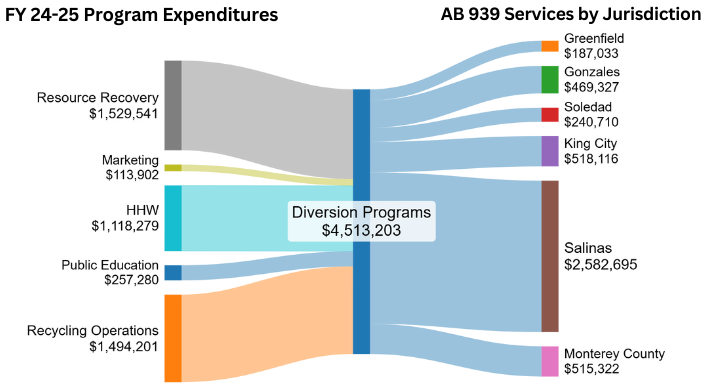
For the first time in 2024-25, AB 939 (fixed, non-landfill diversion related programs) was fully funded without subsidy from landfill disposal tipping fees.
These grants reflect SVR’s ongoing commitment to sustainability and community well-being by reducing landfill waste, promoting recycling, and enhancing public services.
SB 1383 LAGP Grants $722,025
2024-2026
This grant aids the state’s landfill reduction goals by funding local food recovery and organics recycling, while also providing cities with compost or mulch to enhance soil health and sustainability.
CRV Recycling CCPPFunds $22,549
2025-2027
Your CRV funds support public recycling bins, water refill stations, and educational campaigns such as
ProtectYourCent ralCoast .org and Highway 101 cleanup efforts.
HHWGrant $90,000
2022-2025
SVR partnered with Clean Earth Environmental Solutions to host mobile household hazardous waste events in rural Salinas Valley areas, providing residents safe, local disposal options.
Montetrey Bay Air Resources District $164,364
2023-2025
$20,000 will help fund a full electric Ford F-150 Lightning Truck . The remaining funds will fund six level two dual port EV charging stations at the main office for SVR and community use.
Tire Amnesty Grants $83,995
2023-2025
Through grant funding, SVR offers free tire disposal events at all three facilities, recycling almost 18 thousand tires this fiscal year.
Montetrey Bay Air Resources District $174,937
Pending
Pending award: Funding was recommended at the MBARD board meeting on 3/24/ 24. Two older 2011 CAT loaders will be replaced with newer models that run cleaner and meet stricter air quality standards.
Our Board and Staff continues to take bold action to protect the beauty and health of our communities. Through targeted funding for the 3E’s: enforcement, eradication, and education, we’re addressing litter and illegal dumping head-on. These efforts include strategic contracts and programs designed to raise public awareness, change behaviors, and restore impacted areas. By investing in proactive solutions, we’re not just helping to clean up—we’re creating lasting change for the environment and the people who live and work here.
Litter Abatement Agreement with County of Monterey
Since 2018-19 the Board has reserved annually $100,000 in funds for Monterey County’s Roadside Litter Abatement Program. This funding has greatly assisted in cleaning up the notable increase in illegal dumping and litter in and around the rural farm areas. This year the Board approved increasing our funding to $125,000 annually.
Countywide Disposal Voucher Program
SVR participates in the Disposal Voucher Program lead by the County of Monterey which allows residents and organizations free disposal for materials from cleanups or assist with illegal dumping locations. Once an application is approved and disposal vouchers assigned, volunteers can bring waste to the Johnson Canyon Landfill or Jolon Road Transfer Station for proper disposal. This program provides volunteers the framework and resources necessary to keep our communities clean.
Partnerships with Organizations
SVR has partnered with the Pajaro River Flood Management Agency to provide waste disposal for the cleanup of the areas surrounding the Pajaro Levee. SVR Board has approved funding for $25,000.
Illegal Dumping & Litter Abatement Task Force (IDALATF)
SVR participates in the County’s Illegal Dumping Task Force which focuses on the 3E’s: enforcement, eradication, and education to reduce illegal dumping within Monterey County. The Task Force works alongside local partners to identify problem areas, coordinate enforcement and clean-up efforts, and implement prevention strategies.
SVR powered a year of creative and community-driven outreach to support SB 1383 food waste and recycling efforts, with over 890 activities including school trainings, events, and door-to-door visits.
Residents across the Salinas Valley were engaged through bilingual presentations, hands-on demos, and educational materials like brochures and kitchen pails.
The Resource Recovery team wowed the crowd at the 2025 Trashion Show in King City, supporting the Alliance on Aging’s fundraiser with a creative upcycled design. Technician Julia Brooker modeled “Redusa the Recycling Fairy,” a whimsical look made from bubble wrap, newspaper, straws, fabric scraps, and compostable bags. Inspired by a Sesame Street character, Redusa reminded the audience to wish wisely—and not wish-cycle!
In partnership with SGA Marketing, SVR launched a vibrant, multilingual media campaign that reached over 15 million impressions through eye-catching billboards, digital ads, and local radio and TV—making recycling and composting feel easy, inspiring, and within reach for all.
SVR hosted Wally’s Recycle Fest (in conjunction with America Recycles Day). We celebrated our shared successes in diversion with family-friendly games, free bikes from Greenfield Community Science Workshop, food, workshops, compost, and giveaways!
School Programs
SVR launched custom food waste programs at multiple schools, trained staff and students, and delivered over a dozen engaging classroom lessons.
Youth Council
Our second Youth Council (YC) cohort of 15 students from five (5) high schools led real change on campus. They redesigned bin labels, launched sustainability projects, restored native gardens, and produced educational videos. YC members also presented to our Board, gaining leadership experience and amplifying youth voices in local environmental action.
Ed Center
The Wally Waste-Not Education Center & Garden are in full swing. SVR welcomed 18 classes and approx. 350 students on eye-opening field trips.
Thanks to SVR’s Bus Grant program, five (5) classes attended free of cost. These hands-on experiences enhanced students’ understanding of waste, composting, and responsibility. Visits brought lessons to life, showing real-world composting & recycling.
Pollinator Garden
A new pollinator area was established this year, featuring;
- over 200 new native pollinator plants,
- four (4) oak trees, and
- two (2) transplanted avocado trees growing from the composting system.
Additionally, two (2) fig tree branches were transplanted from Jardin El Sol and are thriving! To control weeds, 20 cubic yards (cy) of cardboard and over 100cy of wood chips were added.
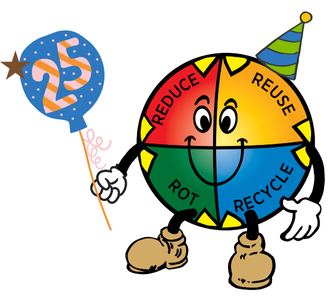
Wally Waste-Not has come a long way since debuting in 2000 as a student-designed recycling robot. Created by Alvarez High student Beatriz Macias, Wally became SVR’s beloved mascot—appearing at school assemblies, community events, and local parades. Now with a modern look and vibrant colors, Wally represents SVR’s continued mission to build a future without landfills.
Each of Wally’s arrows represents a key zero-waste action: REDUCE (red) reminds us to refuse and rethink what we consume; REUSE (gold) encourages using what we already have; RECYCLE (blue) focuses on properly sorting materials; and ROT (green) promotes composting food and yard waste. With Wally leading the way, SVR inspires simple actions that make a big difference.
Johnson Canyon Landfill
Landfill Services
The Johnson Canyon Landfill serves the residents and businesses of the Salinas Valley. It’s the only facility in Monterey County open seven (7) days a week, with customer visits increasing by 5% from last year.
De-packager Facility
To support our local agriculture packaging industry, the De-packager was established to process packaged food and produce. Since inception over 23,600 tons have been diverted from the landfill.
Composting Services
Annually, over 50,000 tons of yard waste and food scraps are processed, turned into compost, and redistributed into the local community.
Recycling Programs
Various recycling programs are on site to maximize diverting materials from the landfill. Tires, Mattresses, C&D, Clothing, Cardboard, Electronics, Paint, Batteries, and many more are some of the programs on site.
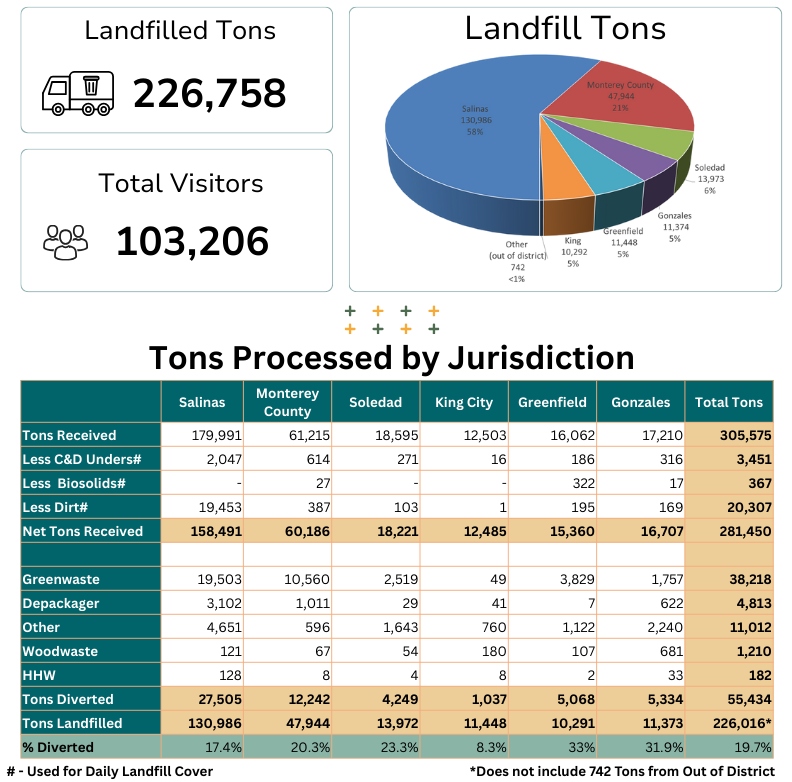
Tons landfilled: 226,758
Customer Visits: 73,697
Tons Recycle/Diverted From Landfill: 86,733
The Jolon Transfer Station proudly serves the southern
portion of the Salinas Valley, providing residents and
businesses with a reliable and convenient location for the proper disposal and transfer of waste materials. Over the past several months, the facility has undergone a series of upgrades and improvements designed to enhance both efficiency and customer experience. These improvements not only strengthen the station’s ability to manage the region’s waste responsibly but also ensure that the site continues to operate as a valuable community asset for years to come.
In September 2024 the Board approved a full replacement of the original road leading to the entrance of the facility and scalehouse, as well as new asphalt for the current dirt access road to the newly built transfer station and staff offices.
In November 2024, the Board approved the purchase and installation of a Fire Rover which is a remote fire detection and suppression system. SVR staff extended the electrical power needed to power the system and poured a concrete pad for the equipment.
Tons Process through site: 20,835
Customer Visits: 16,249
The Madison Lane Recycling & Household Hazardous Waste Facility (HHW) is a permanent drop-off location that allows proper disposal of unwanted hazardous materials. Residents of Monterey County may drive up during normal business hours. A trained staff member will greet the resident at their vehicle, take some basic information, and begin unloading the vehicle. All of the items collected are properly managed to be reused, recycled or disposed of in compliance with federal, state and local laws.
Residents can bring a maximum of 15 gallons or 125 lbs. of hazardous waste per household and is accepted every 30 days for free. Businesses are required to make an appointment and can bring a maximum of 25 gallons or 220 lbs. per month for a fee.
Accepted Items at No Charge
- Appliances (stoves, washing machines, water heaters, etc.)
- Cardboard
- Carpet and Carpet Padding
- Clothing and Shoes
- Mattresses and Box Springs
- Electronics (computers, TVs, monitors, etc.)
- Recycling (separated): Paper, Plastic, Glass Containers, and Metal Cans
- Scrap Metal
- Rigid Plastics
Chemicals Processed Through Site: 375K lbs.
Customer Visits: 4,832
Recycling Processed Through Site: 1,475 Tons
Keeping Recycling and Disposal Facilities running smoothly requires a lot of people-power and machinery. Below are just a few of the many key players and their equipment that keep this agency flowing.
D8T Dozer – Heaving Equipment Operators
This giant piece of equipment weights 90,000 lbs.
Our Heavy Equipment Operators run one of these and three smaller D6 dozers at the Johnson Canyon Landfill to place waste into the active face, cover, and finish slopes.
Transfer Truck Drivers
Moving waste and recycling takes a lot of trucks. Our agency has a fleet of 12 Transfer Trucks driven by 8 Drivers. Each truck can transport up 40,000 lbs. of recyclable materials or trash. A transfer driver averages approximately 39,000 miles driven annually.
Diversion Workers
Our boots on the ground warriors! Our Diversion Workers assist and guide customers while providing excellent customer service and directing customers to the appropriate location for recycling and waste disposal. They work in all types of weather elements, all while ensuring everyone’s safety.
Solid Waste Technicians & Mechanics
Keeping all the equipment and environmental control systems running smoothly is hard work. Our Solid Waste Technicians & Mechanics are the “jack of all trades” working behind the scenes to keep our systems and machinery running.
Follow us on social media to learn more about our hardworking staff and how they keep our agency running.
SVR has followed its strategic path of financial sustainability for over 13 years by focusing on reducing or eliminating debt and liabilities, and importantly, saving-as-we-go for future capital and public infrastructure investment. Over the next several years the fiscal discipline of SVRs Board of Directors will culminate in construction of many new public service facility improvement projects, all paid for with accrued savings and No Debt!
Johnson Canyon Landfill Module 8 Construction
Landfills are built in sections or “Modules”. As one module is filled up the next one is constructed. SVR Board policy has been to set aside $5.00 for every ton of waste landfilled to fund the construction of the next module. The next module is No. 8 and is scheduled to start construction in 2026-27 and should be fully funded by the time work begins.
Johnson Canyon Entrance Relocation
Due to a dramatic increase in the use of this site for self-hauling customers and demand for SVR recycling services, a new entrance is proposed at the west end of the facility to allow for 1) an expanded public materials recovery center (MRC) for recycling collection and processing, 2) more off-street space for vehicle cueing off Johnson Canyon Road; and 3) a new scalehouse facility and truck scales to improve movement of customers and garbage collection vehicles in and out of the site.
North County Recycling and Transfer Station
Due to the high demand for SVR’s low-cost services in north Monterey County and to assist with the reduction of illegal dumping in this region, SVR’s Board has approved moving forward with the environmental review and permitting processes to pursue construction of a new public recycling center and transfer station on the site of the closed Crazy Horse Landfill. This area is SVR’s second-largest service region, behind the City of Salinas, and will greatly benefit from having this facility centralized in north county to conveniently serve its residents.
Advanced Organics Recovery Technology Solicitation
SVR will be releasing a request for Expressions of Interest & Statements of Qualifications from qualified companies and contractors able to provide innovative technologies focused on recovery of organic materials (food, paper, cardboard, etc.) still present in the “trash” or solid waste stream, which makes up approximately 60% of what is still going into the landfill. Projects may include paper fiber recovery for reuse, biofuels or bio-energy production, and/or recovery of other resources such as metals, plastics and glass.
Dig deeper by watching Our Story featured on YouTube.